
Friends of the brand
Ana Teles
One fine day
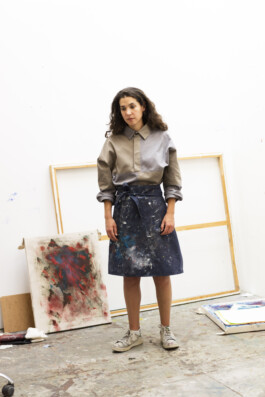
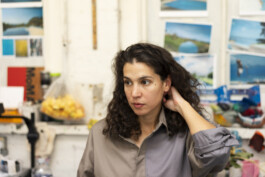
On an insanely humid Friday afternoon, we met up with Ana Teles in her space at Cubitt Studios, close to Angel station in North London. Ana would describe herself as a multidisciplinary artist. I just call her a painter.
Her work is circling around questions of authenticity and the meaning of original and replication. Recently, she earned a practice-based PhD from Chelsea, pushing the concept of copying another artist’s work while collaborating with them, blurring the lines between original and copy.
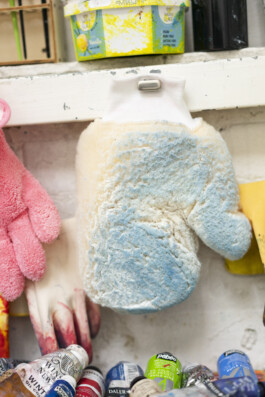
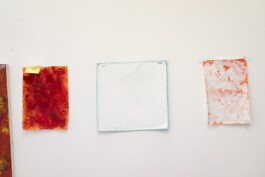
The walls are lined with cryptic Post-it notes
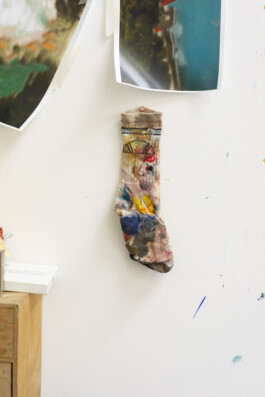
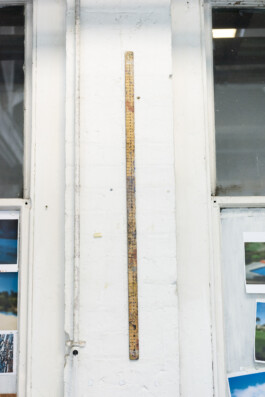
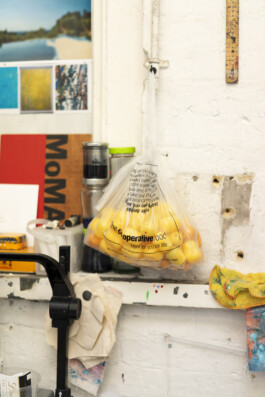
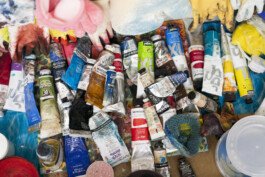
Thanks to showing up on her doorstep on short notice, we got an unspoiled studio set-up, a wonderful mess. Her paintbrushes? Mostly old socks and other makeshift tools.
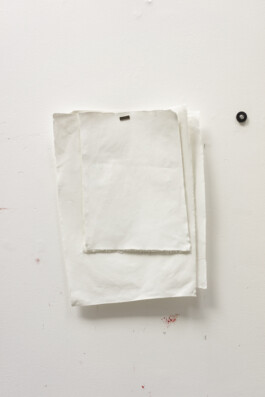
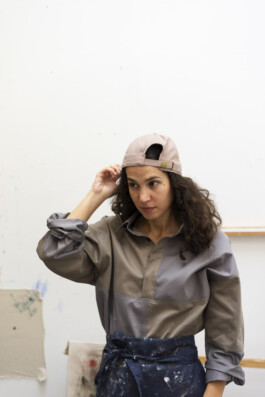
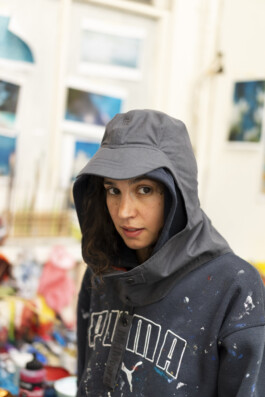
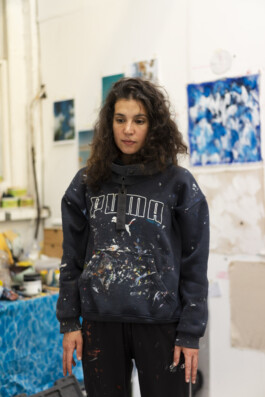
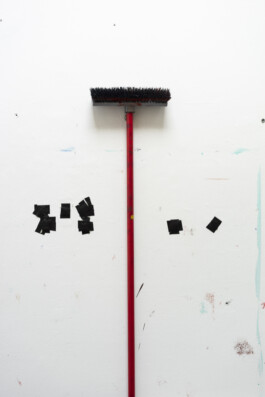
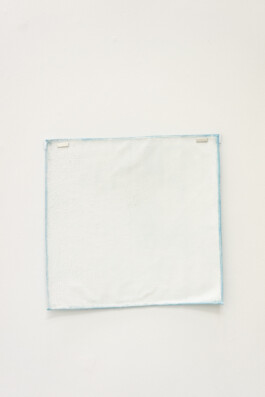
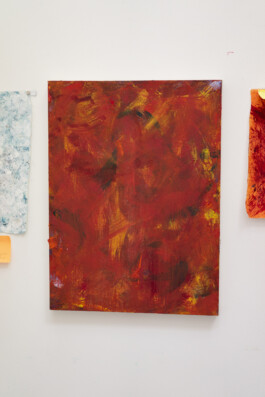
The walls are lined with cryptic Post-it notes next to unfinished paintings. Unfinished, and probably never to be finished, as Ana embraces the provisional in her quest to paint the painting that ends all painting (at least for her). She herself, though, looks very much finished in some Mid Moor and Mountain clobber.
We talked about stealing aprons, copying paintings and how the white waxed cotton anorak could become something akin to a Cy Twombly painting over time itself.
Ana’s new work seems fleeting to me, provisional, but not without weight. Like half-submerged objects in a stream of thoughts and ideas.
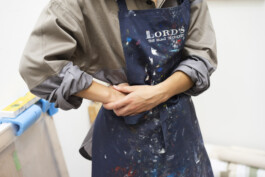
How come you have a Lord’s cricket apron?
P: How come you have a Lord’s cricket apron?
A: Cause I stole it.
P: No tiptoeing around it.
A: I’m actually very proud of stealing it. We were doing catering work, and at the beginning of the day they would give you a uniform which would be this, and at the end of the day they would check your bags to see if you had any of the stuff with you, and I managed to steal an apron, even with security trying to prevent it. They would just look through all the bags to see if we were stealing things.
GUS: That really makes you want to steal something.
A: Yeah, lots of people were stealing aprons and stuff. It was quite horrible that they had security checking the staff's bags at Lord’s cricket ground. I mean, they have so much money.
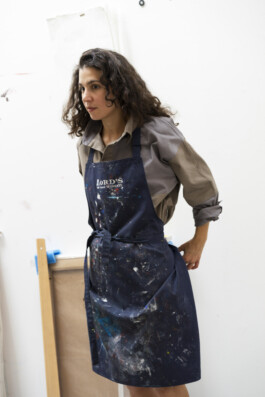
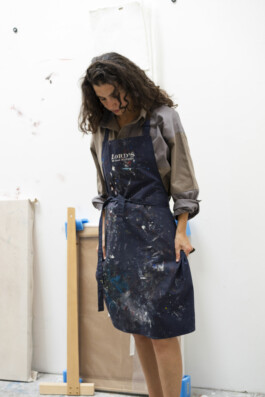
That’s the advantage of being on time
P: Is the work you are doing at the moment still related to copying other artists?
A: No, I’m just doing my own work.
P: You said since your PhD you stepped away from this mode of working.
A: I am stepping away from that, yes, but not very far. I am looking at other things.
P: Because you were quite meticulous in copying. When I met you, and we shared this studio near Elephant and Castle, you were copying a Hopper painting.
A: Yeah, but this was to try something else. That was a transition to my PhD. I still have the painting around.
P: It was not one of his urban scenes, but a depiction of a freestanding house. It was quite beautiful; do you still have this work?
A: Yeah, one of them I actually cut into pieces, because I had a lot of versions of that image.
P: Maybe we can make a swap, an anorak for a painting. I really liked this copy of the Hopper work.
A: I have had a lot of versions of this image painted. One of them I cut into pieces, but I have other versions of that image.
GUS: Why did you cut it into pieces?
A: I can’t remember. I think I cut it into pieces and then I gave it away to people to do something, but they never came back to me. That was a long time ago.
P: When you were copying the Hopper work, were you true to size? Because you were always very meticulous with these details.
A: Not with that.
P: Because it was bigger.
A: It was much larger.
P: Because Hopper usually worked on very small formats.
A: Yeah, I can’t believe that you still remember it. It was very large, but I also did smaller and very small versions.
GUS: Did you guys share a studio?
P: Yes, after graduating I was looking for a studio...
A: I selected him. There were so many people applying, and I thought it is so unfair, so I went for the first person, and that was Philipp. That’s the advantage of being on time.
P: You were conceptually copying artwork, and now after your PhD you are stepping away from this.
A: That approach, but sort of similar questions. I might do an exhibition soon. But not in an art gallery. I am thinking about showing work in about this idea another way. So many people show work all the time, and I think like, what for? I think there are other ways of engaging with your work, maybe a publication or have someone to write a text.
P: Do you think informal, or outside of the general art spaces?
A: Both maybe; I am just tired of the show, everything that comes with an exhibition. Having an exhibition but maybe not invite anyone, or maybe just inviting a few people to come to see the work and talk about it.
A painting that is quite pessimistic, or anti-painting
P: There are a lot of rituals involved in the private view; people also come to a show to socialise.
A: Many of the rituals I am fine with.
P: Would you rather have a mini conference about the work?
A: I am thinking about a conceptual route.
P: Would you be interested in showing the older work, from when you were copying your fellow students? Telling a coherent story of the evolution of the work.
A: No, maybe cut it a bit. Even though there would obviously be connections. I am being evasive on purpose. It’s part of the work.
P: When you say that you are now transitioning away from copying after having finished the PhD but you still haven’t completely separated from the concept...
A: You know.. I am thinking about the rejection side of making work… does that make sense… You can look at the work as copies of other people's work and sort of other ideas, but I am now looking at it as a rejection of adopting a specific language or resisting being affirmative.
P: Affirmative of what?
A: A language of making paintings.
P: Is the idea of not showing in conventional art spaces also related to the idea of rejection?
A: I wasn’t even thinking about it. Maybe it is, but if it is a total rejection, then what bother making paintings or making an exhibition. What’s the point?
P: Do you have an answer?
A: I don’t have an answer. … I have been looking at, maybe quite cliché now, the provisional, you know the provisional paintings, a sort of concept, someone sort of coined, a specific painting that is a painting that is quite pessimistic, or anti-painting… in a way that you sort of reject to make a very finished, complete painting, for all sorts of reasons. I have been reading this book, and it actually makes sense and is relates to my paintings and all the other work as well.
P: Who coined this term?
A: Someone called Raphael or something; I have the book in my bag. …it’s just something I was thinking about, trying to understand my work as well.
There is a lot of questioning, self-doubt, and self-sabotage in the process
P: Maybe there is not a great connection at all, but are you at all interested in Arte Povera? Is this something that informs your work, or could?
A: It could do.
P: Looking around here, it could also be a studio in Rome in the 70s.
A: Yeah, some of these artists… the provisional painters use discarded materials, cheap materials.
P: What’s your main approach to keep a painting un-painterly? Keep it provisional, is it not finishing it?
A: I don’t know. I haven’t really done this on purpose; now thinking about the work, it makes sense why I start painting, and I never want to finish, never want to think of my painting as paintings, but I want them to be something… I know that I am contradicting myself.
P: …not really. Is it that the word provisional just resonated with you…
A: Yeah, this idea of not wanting to make a very shiny, finished painterly painting, but I still very much want to belong and want to be part of the discourse of painting. And still be very interested in some of these questions, but then there is a lot of questioning, self-doubt, and self-sabotage in the process. That’s what I mean.
P: When you say self-sabotage, how does that look in the studio context?
A: It is even the use of the improvised painting materials, all that stuff; it really works against me. They don’t put much paint on. I am struggling to put a mark on the painting; they resist a lot – it’s the complete opposite of a brush. Even though you have this kind of mark making…
P: So you choose tools that are blunt, in order to make something that isn't refined?
A: Yeah. Why? – I have no idea. Yeah, why do I not just use a brush, apart from the fact that I don’t want to wash them? I could still use a brush. Not wash it and just throw them away… I could do that. I don’t really like washing brushes, but I can do it very well.
P: How did you do the transition from copying artists… you were quite disciplined with that. Or were you always doing other works on the side? Is it hard to free yourself once you are locked into a conceptual and stringent practise.
A: I didn’t see that I locked myself into that. The majority of the people would know my work has that; some people, I mean in the UK, yes. But I think there is also some connection with the work - I mean this idea of the provisional, the resistant self-sabotage or whatever, with the idea of copy and rejecting to have your own visual language and to use other people's work.
P: Could it on some level be a rejection of individuality, like having your own standpoint. Being an artist, being part of the discourse, but avoiding adding an individual standpoint.
A: In the copying sense?! It could be seen like that as well. It was also… part of the reason that I did that. It wasn’t just questioning the idea of authenticity and artistic identity; there was a part of me that I didn’t want to be an artist in …(pause)
P: …in the Western sense, with an individual standpoint and creating a persona in a way.
A: Yeah. I mean I don’t make these things consciously; it just happens.
Every time I come to the studio, I am very optimistic
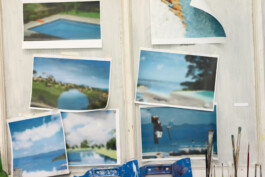
P: What about these print-outs from a swimming pool?
A: Yeah, that was for something else, that just stayed there. It reminds me of Summer.
(Pause)
A: Every time I come to the studio, I am very optimistic; I think that’s it, I am gonna make The Painting. Cause it’s in my head what I want to make. But I always fail to make that. And I always stop myself of continuing the painting and thinking about a painting as painting. Yeah, it’s like this is enough; it does not interest me anymore, so I start again, and I get really excited, you know, it’s in my head, and I go, no – next! Then it happens… I don’t want to make decisions. Do I use blue or green – next! Why do I have to think of these aesthetic choices? Next! Does that make sense? But at the same time I also really enjoy thinking about painting in that way. But I just stop myself. When I am doing it, it doesn’t interest me.
P: So, it's a bit like you are rolling a rock up the hill, and then halfway you let it go.
A: But I am very optimistic. I am very optimistic, I am. I mean, I’ve been doing this… the investment I have put into painting and art. So, I am going to make this painting one day.
P: And then you are done?!
A: Yeah. Maybe then I am done.
P: Maybe someday, when you don’t expected, you go to the studio, and you make the painting you have had in mind, and then you can retire and start something else.
A: Yeah. Starting my own fashion brand.
P: Why not?! I can always consult you.
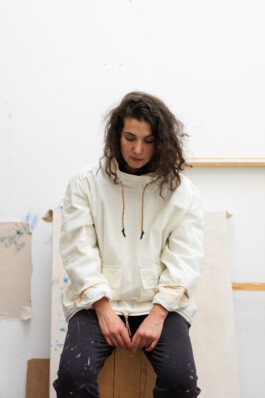
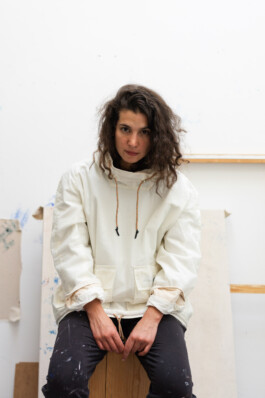
PHOTOGRAPHY Philipp Dorl
MODEL Ana Teles
PRODUCTION Gus Burgess
ASSISTANCE Jena Edgecombe
LOCATION Cubitt Studios, Angel, London
© by Philipp Dorl for Mid Moor and Mountain® Studio London/Berlin, 2025
Friends of the brand
Ana Teles
One fine day
On an insanely humid Friday afternoon, we met up with Ana Teles in her space at Cubitt Studios, close to Angel station in North London. Ana would describe herself as a multidisciplinary artist. I just call her a painter.
Her work is circling around questions of authenticity and the meaning of original and replication. Recently, she earned a practice-based PhD from Chelsea, pushing the concept of copying another artist’s work while collaborating with them, blurring the lines between original and copy.
The walls are lined with cryptic Post-it notes
Thanks to showing up on her doorstep on short notice, we got an unspoiled studio set-up, a wonderful mess. Her paintbrushes? Mostly old socks and other makeshift tools. The walls are lined with cryptic Post-it notes next to unfinished paintings. Unfinished, and probably never to be finished, as Ana embraces the provisional in her quest to paint the painting that ends all painting (at least for her). She herself, though, looks very much finished in some Mid Moor and Mountain clobber.
How come you have a Lord’s cricket apron?
We talked about stealing aprons, copying paintings and how the white waxed cotton anorak could become something akin to a Cy Twombly painting over time itself. Ana’s new work seems fleeting to me, provisional, but not without weight. Like half-submerged objects in a stream of thoughts and ideas.
P: How come you have a Lord’s cricket apron?
A: Cause I stole it.
P: No tiptoeing around it.
A: I’m actually very proud of stealing it. We were doing catering work, and at the beginning of the day they would give you a uniform which would be this, and at the end of the day they would check your bags to see if you had any of the stuff with you, and I managed to steal an apron, even with security trying to prevent it. They would just look through all the bags to see if we were stealing things.
GUS: That really makes you want to steal something.
A: Yeah, lots of people were stealing aprons and stuff. It was quite horrible that they had security checking the staff's bags at Lord’s cricket ground. I mean, they have so much money.
P: Is the work you are doing at the moment still related to copying other artists?
A: No, I’m just doing my own work.
P: You said since your PhD you stepped away from this mode of working.
A: I am stepping away from that, yes, but not very far. I am looking at other things.
P: Because you were quite meticulous in copying. When I met you, and we shared this studio near Elephant and Castle, you were copying a Hopper painting.
A: Yeah, but this was to try something else. That was a transition to my PhD. I still have the painting around.
P: It was not one of his urban scenes, but a depiction of a freestanding house. It was quite beautiful; do you still have this work?
A: Yeah, one of them I actually cut into pieces, because I had a lot of versions of that image.
P: Maybe we can make a swap, an anorak for a painting. I really liked this copy of the Hopper work.
A: I have had a lot of versions of this image painted. One of them I cut into pieces, but I have other versions of that image.
GUS: Why did you cut it into pieces?
A: I can’t remember. I think I cut it into pieces and then I gave it away to people to do something, but they never came back to me. That was a long time ago.
The advantage of being on time
P: When you were copying the Hopper work, were you true to size? Because you were always very meticulous with these details.
A: Not with that.
P: Because it was bigger.
A: It was much larger.
P: Because Hopper usually worked on very small formats.
A: Yeah, I can’t believe that you still remember it. It was very large, but I also did smaller and very small versions.
GUS: Did you guys share a studio?
P: Yes, after graduating I was looking for a studio...
A: I selected him. There were so many people applying, and I thought it is so unfair, so I went for the first person, and that was Philipp. That’s the advantage of being on time.
P: You were conceptually copying artwork, and now after your PhD you are stepping away from this.
A: That approach, but sort of similar questions. I might do an exhibition soon. But not in an art gallery. I am thinking about showing work in about this idea another way. So many people show work all the time, and I think like, what for? I think there are other ways of engaging with your work, maybe a publication or have someone to write a text.
P: Do you think informal, or outside of the general art spaces?
A: Both maybe; I am just tired of the show, everything that comes with an exhibition. Having an exhibition but maybe not invite anyone, or maybe just inviting a few people to come to see the work and talk about it.
A painting that is quite pessimistic, or anti-painting
P: There are a lot of rituals involved in the private view; people also come to a show to socialise.
A: Many of the rituals I am fine with.
P: Would you rather have a mini conference about the work?
A: I am thinking about a conceptual route.
P: Would you be interested in showing the older work, from when you were copying your fellow students? Telling a coherent story of the evolution of the work.
A: No, maybe cut it a bit. Even though there would obviously be connections. I am being evasive on purpose. It’s part of the work.
P: When you say that you are now transitioning away from copying after having finished the PhD but you still haven’t completely separated from the concept...
A: You know.. I am thinking about the rejection side of making work… does that make sense… You can look at the work as copies of other people's work and sort of other ideas, but I am now looking at it as a rejection of adopting a specific language or resisting being affirmative.
P: Affirmative of what?
A: A language of making paintings.
P: Is the idea of not showing in conventional art spaces also related to the idea of rejection?
A: I wasn’t even thinking about it. Maybe it is, but if it is a total rejection, then what bother making paintings or making an exhibition. What’s the point?
P: Do you have an answer?
A: I don’t have an answer. … I have been looking at, maybe quite cliché now, the provisional, you know the provisional paintings, a sort of concept, someone sort of coined, a specific painting that is a painting that is quite pessimistic, or anti-painting… in a way that you sort of reject to make a very finished, complete painting, for all sorts of reasons. I have been reading this book, and it actually makes sense and is relates to my paintings and all the other work as well.
P: Who coined this term?
A: Someone called Raphael or something; I have the book in my bag. …it’s just something I was thinking about, trying to understand my work as well.
There is a lot of questioning, self-doubt, and self-sabotage in the process
P: Maybe there is not a great connection at all, but are you at all interested in Arte Povera? Is this something that informs your work, or could?
A: It could do.
P: Looking around here, it could also be a studio in Rome in the 70s.
A: Yeah, some of these artists… the provisional painters use discarded materials, cheap materials.
P: What’s your main approach to keep a painting un-painterly? Keep it provisional, is it not finishing it?
A: I don’t know. I haven’t really done this on purpose; now thinking about the work, it makes sense why I start painting, and I never want to finish, never want to think of my painting as paintings, but I want them to be something… I know that I am contradicting myself.
P: …not really. Is it that the word provisional just resonated with you…
A: Yeah, this idea of not wanting to make a very shiny, finished painterly painting, but I still very much want to belong and want to be part of the discourse of painting. And still be very interested in some of these questions, but then there is a lot of questioning, self-doubt, and self-sabotage in the process. That’s what I mean.
P: When you say self-sabotage, how does that look in the studio context?
A: It is even the use of the improvised painting materials, all that stuff; it really works against me. They don’t put much paint on. I am struggling to put a mark on the painting; they resist a lot – it’s the complete opposite of a brush. Even though you have this kind of mark making…
P: So you choose tools that are blunt, in order to make something that isn't refined?
A: Yeah. Why? – I have no idea. Yeah, why do I not just use a brush, apart from the fact that I don’t want to wash them? I could still use a brush. Not wash it and just throw them away… I could do that. I don’t really like washing brushes, but I can do it very well.
P: How did you do the transition from copying artists… you were quite disciplined with that. Or were you always doing other works on the side? Is it hard to free yourself once you are locked into a conceptual and stringent practise.
A: I didn’t see that I locked myself into that. The majority of the people would know my work has that; some people, I mean in the UK, yes. But I think there is also some connection with the work - I mean this idea of the provisional, the resistant self-sabotage or whatever, with the idea of copy and rejecting to have your own visual language and to use other people's work.
P: Could it on some level be a rejection of individuality, like having your own standpoint. Being an artist, being part of the discourse, but avoiding adding an individual standpoint.
A: In the copying sense?! It could be seen like that as well. It was also… part of the reason that I did that. It wasn’t just questioning the idea of authenticity and artistic identity; there was a part of me that I didn’t want to be an artist in …(pause)
P: …in the Western sense, with an individual standpoint and creating a persona in a way.
A: Yeah. I mean I don’t make these things consciously; it just happens.
Every time I come to the studio, I am very optimistic
P: What about these print-outs from a swimming pool?
A: Yeah, that was for something else, that just stayed there. It reminds me of Summer.
(Pause)
A: Every time I come to the studio, I am very optimistic; I think that’s it, I am gonna make The Painting. Cause it’s in my head what I want to make. But I always fail to make that. And I always stop myself of continuing the painting and thinking about a painting as painting. Yeah, it’s like this is enough; it does not interest me anymore, so I start again, and I get really excited, you know, it’s in my head, and I go, no – next! Then it happens… I don’t want to make decisions. Do I use blue or green – next! Why do I have to think of these aesthetic choices? Next! Does that make sense? But at the same time I also really enjoy thinking about painting in that way. But I just stop myself. When I am doing it, it doesn’t interest me.
P: So, it's a bit like you are rolling a rock up the hill, and then halfway you let it go.
A: But I am very optimistic. I am very optimistic, I am. I mean, I’ve been doing this… the investment I have put into painting and art. So, I am going to make this painting one day.
P: And then you are done?!
A: Yeah. Maybe then I am done.
P: Maybe someday, when you don’t expected, you go to the studio, and you make the painting you have had in mind, and then you can retire and start something else.
A: Yeah. Starting my own fashion brand.
P: Why not?! I can always consult you.
PHOTOGRAPHY Philipp Dorl
MODEL Ana Teles
PRODUCTION Gus Burgess
ASSISTANCE Jena Edgecombe
LOCATION Cubitt Studios, Angel, London
© by Philipp Dorl for Mid Moor and Mountain® Studio London/Berlin, 2025